Understanding Radon
of homes across Canada have radon levels exceeding the safe limit of 200 Bq/m³.
Source: StatCanof homes specifically in the Outaouais region test above the accepted 200 Bq/m³ threshold.
Source: StatCanof homes in the Laval region also exceed the acceptable Health Canada safety standards.
Source: StatCanThe Health Risks:
Radon is the leading cause of lung cancer in non-smokers and accounts for 16% of all lung cancer deaths in the country. Because the gas is entirely undetectable by human senses, it easily bypasses our natural defenses when inhaled.
As it sits inside the lungs, it undergoes radioactive decay, rapidly emitting heavy, high-energy particles known as alpha particles. When these alpha particles collide with the delicate cellular lining of the respiratory tract, they act like tiny dense projectiles, physically shattering the DNA strands of your lung tissue. Over time, this microscopic cellular destruction can cause the mutated cell reproduction that leads directly to cancer.
On the Periodic Table:
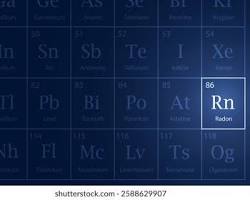
On the periodic table, radon is a chemical element with the symbol Rn and atomic number 86. Found at the very bottom of the noble gas group, it is naturally colorless, odorless, and tasteless. Unlike its lighter noble gas cousins (such as helium or neon), radon is intensely heavy, chemically unreactive under normal conditions, and uniquely hazardous because it is highly radioactive.
Official Government of Canada Resources
For comprehensive research, national safety guidelines, and additional statistics regarding risk management, visit the Health Canada Radon Portal.
Go to Health Canada Website →